λL ≤ 2πkBT/ℏ
Theoretical Physics
Black Holes & Quantum Chaos
A scientific exploration of black hole physics through quantum chaos theory, covering Schwarzschild and Kerr geometries, information scrambling dynamics, the MSS bound, and holographic correspondences.
Event Horizon
Hawking Radiation
Information Paradox
OTOC
Lyapunov Exponent
AdS/CFT
Observational Data
Observed Black Holes
Real black holes from EHT, LIGO/Virgo, and multi-wavelength observations. Select one to see calculated properties.
Black Hole Catalog
Calculated Properties
Geometry
Object
-
Schwarzschild radius
-
ISCO (Kerr)
-
Spin parameter
-
Thermodynamics
Hawking temperature
-
Bekenstein-Hawking entropy
-
Evaporation time
-
Quantum Chaos
Lyapunov bound (λL)
-
Scrambling time (t*)
-
Key Formulas
rs = 2GM/c²
TH = ℏc³/(8πGMkB)
SBH = kBA/(4lP²)
λL ≤ 2πkBT/ℏ
Black Hole Fundamentals
Black Hole Anatomy
Fundamental structure and properties of black holes based on Einstein's general relativity.
Singularity
A point of infinite density at the center of a black hole. All known laws of physics break down here.
ρ → ∞
Singularity density
Event Horizon
The boundary from which nothing, including light, can escape. Radius determined by mass.
rs = 2GM/c²
Schwarzschild radius
Photon Sphere
Unstable circular orbit for photons at r = 1.5rs. Light can temporarily orbit.
rph = 3GM/c²
Photon sphere radius
Accretion Disk
Matter spinning and falling into the black hole, emitting intense radiation due to frictional heating.
L = ηṀc²
Accretion luminosity (η ≈ 0.1)
Ergosphere
Region outside the event horizon of a rotating (Kerr) black hole where spacetime is dragged by rotation.
re = M + √(M² - a²cos²θ)
Ergosphere outer boundary
ISCO
Innermost Stable Circular Orbit - the deepest stable circular orbit before matter spirals inward.
rISCO = 6GM/c² (Schwarzschild)
3rs for non-rotating
Black Hole Classification
Schwarzschild
Non-rotating, uncharged. The simplest solution to Einstein's equations.
ds² = -(1-2M/r)dt² + (1-2M/r)⁻¹dr² + r²dΩ²
Kerr
Rotating, uncharged. The most realistic model for astrophysical black holes.
Has spin parameter a = J/Mc
Reissner-Nordström
Non-rotating, charged. Has two horizons (inner & outer).
r± = M ± √(M² - Q²)
Kerr-Newman
Rotating and charged. The most general solution for electrovacuum black holes.
Combination of parameters M, J, Q
Quantum Chaos in Black Holes
Chaos & Scrambling
Black holes as maximally chaotic systems - quantum information scrambling and connection with holography.
Lyapunov Exponent
In classical chaotic systems, distance between trajectories grows exponentially: δx(t) ~ eλt. Black holes have a maximal Lyapunov exponent bounded by quantum mechanics.
Maldacena-Shenker-Stanford bound (2016). Black holes saturate this bound in holographic theories.
For Black Hole:
λBH = 2πTH = κ
(surface gravity)
OTOC
Out-of-Time-Order Correlator - the main diagnostic for quantum chaos.
C(t) = ⟨[W(t), V]†[W(t), V]⟩
Measures how fast perturbations spread in a quantum system.
Scrambling Time
Time required for information to "scramble" evenly throughout the system.
t* ~ (ℏ/2πT) log S
S = Bekenstein-Hawking entropy. For BH: t* ~ rs log(S)
Quasinormal Modes
Black hole oscillation modes that decay exponentially - fingerprint of chaos.
ω = ωR - iωI
Poles in Green's function, related to Lyapunov exponent.
Holographic Duality & SYK Model
AdS/CFT Correspondence
Duality between gravity in Anti-de Sitter (AdS) space and Conformal Field Theory (CFT) on its boundary. Black hole in bulk ↔ thermal state on boundary.
AdS₍ᵈ₊₁₎ Gravity
⟷
CFT₍ᵈ₎
SYK Model
Sachdev-Ye-Kitaev model - system of N fermions with random interactions. Maximally chaotic and has a gravitational dual in nearly-AdS₂.
H = Σijkl Jijkl ψiψjψkψl
Butterfly Effect
In holography, small perturbations at the boundary "fall" into the black hole and spread chaotically.
vB = √(d/2(d-1)) × 2πT
vB = butterfly velocity
Research Applications
01
Information Scrambling Dynamics
Study of how quantum information spreads within the horizon - key to understanding the information paradox.
02
Quantum Circuit Complexity
Connection between volume of the region behind the horizon and computational complexity of the dual quantum state.
03
Eigenstate Thermalization
How individual black hole eigenstates encode thermal physics - ETH in gravitational systems.
04
Random Matrix Theory
Level spacing statistics of quasinormal modes follow random matrix distributions (GUE/GOE).
Black Hole Thermodynamics
Laws of Black Hole Mechanics
Fundamental relationship between gravity, thermodynamics, and quantum mechanics.
0
Zeroth Law
Surface gravity κ is constant on the event horizon of a stationary black hole.
T constant at equilibrium
↔
κ constant on horizon
1
First Law
Mass change is related to area change, angular momentum, and charge.
dM = (κ/8π)dA + ΩdJ + ΦdQ
dE = TdS + work
↔
dM = (κ/8π)dA + ...
2
Second Law
Event horizon area never decreases in any classical process.
δA ≥ 0
Entropy S never decreases
↔
Area A never decreases
3
Third Law
It is impossible to reduce surface gravity κ to zero through any finite physical process.
T = 0 is unattainable
↔
κ = 0 (extremal) is unattainable
Hawking Radiation
Hawking's discovery (1974) that black holes radiate thermally demonstrated that the thermodynamic analogy is remarkably precise - black holes truly have temperature and entropy.
Hawking Temperature
TH = ℏκ/2πkBc = ℏc³/8πGMkB
For M = M☉: T ≈ 60 nanoKelvin
Bekenstein-Hawking Entropy
SBH = kBA/4lP² = kBc³A/4Gℏ
Entropy proportional to AREA, not volume!
Evaporation Time
tevap ≈ 5120πG²M³/ℏc⁴
For M = M☉: t ≈ 10⁶⁷ years
+
−
Virtual pair creation near horizon
Information Paradox
If a black hole fully evaporates via Hawking radiation (which is thermal/random), where does the information about what fell in go? This conflicts with quantum mechanical unitarity!
Page Curve
Radiation entropy initially rises, then falls after "Page time" - information exits gradually.
Island Formula
Generalized entropy formula with "quantum extremal surfaces" reproduces the Page curve.
ER = EPR
Entanglement (EPR) is equivalent to wormholes (Einstein-Rosen bridge) - Maldacena & Susskind.
Firewall?
AMPS paradox: is there a "firewall" at the horizon that destroys infalling observers?
Observational Evidence
Black Holes in Nature
Observational evidence for the existence of black holes from various astronomical methods.
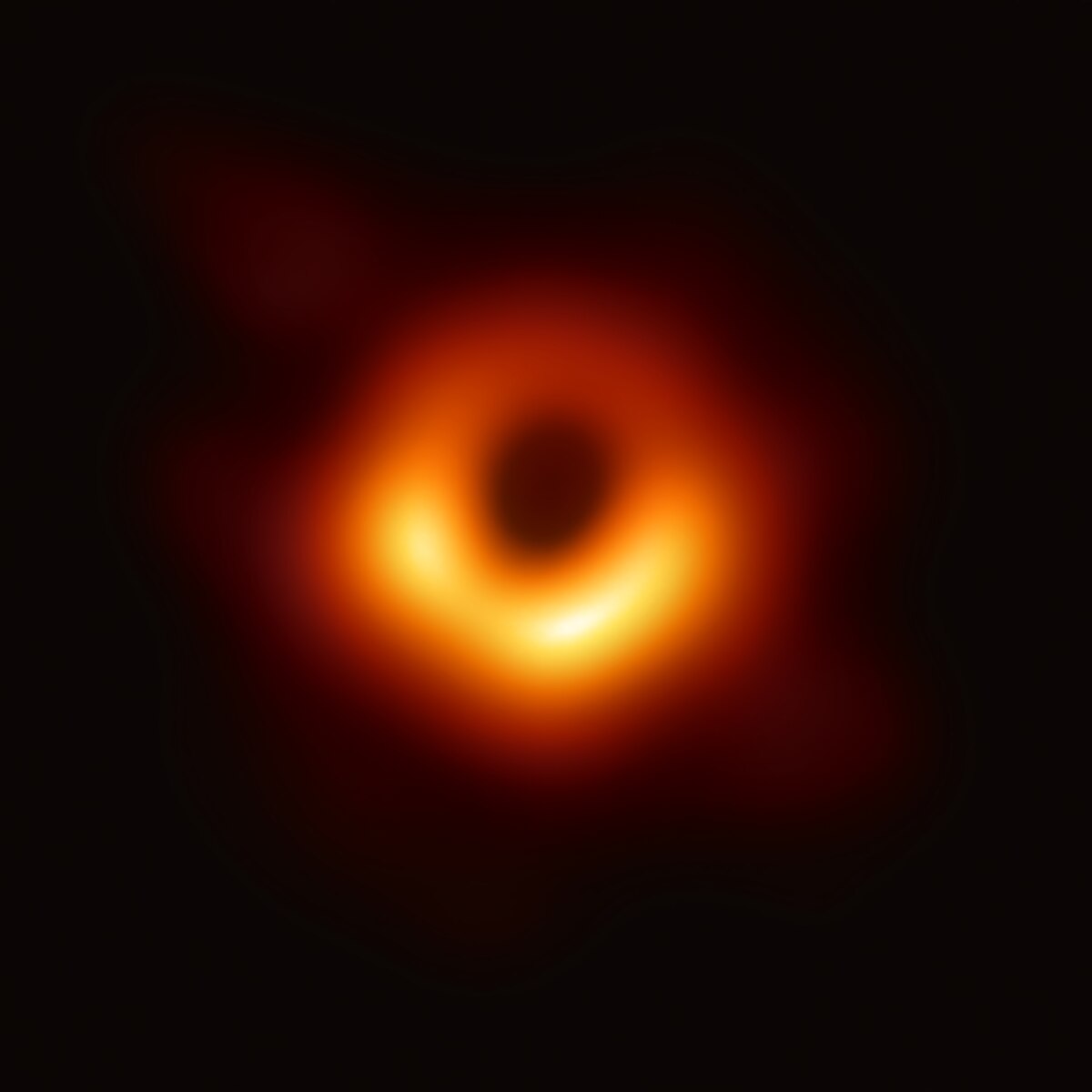
EHT 2019
M87* - First Direct Image
First direct image of a supermassive black hole at the center of Messier 87 galaxy. Mass ~6.5 billion M☉, distance 55 million light years.
6.5 × 10⁹ M☉
Mass
55 Mly
Distance
~40 μas
Angular Size
Sagittarius A*
Supermassive black hole at the center of the Milky Way. Orbits of S-stars provide undeniable evidence.
4 × 10⁶ M☉ mass
27,000 ly distance
Gravitational Waves
LIGO/Virgo detects binary black hole mergers. GW150914: ~36 + 29 M☉ → 62 M☉
90+ detections
~3 M☉c² radiated
X-ray Binaries
Binary star systems with stellar-mass black holes. Matter accretion emits intense X-rays.
Cygnus X-1
~21 M☉
Quasars & AGN
Active galactic nuclei powered by supermassive black holes - the most luminous sources in the universe.
L ~ 1047 erg/s
z > 7 furthest
NASA Black Hole Gallery
Visualizations & Simulations
Collection of black hole images and visualizations from NASA and global observatories.
Loading NASA images...
Key References
Literature & Resources
Paper
Maldacena, Shenker, Stanford (2016)
"A bound on chaos" - arXiv:1503.01409
Paper
Sachdev & Ye (1993)
SYK model foundations - Phys. Rev. Lett. 70, 3339
Paper
Hawking (1974)
"Black hole explosions?" - Nature 248, 30-31
Paper
Bekenstein (1973)
"Black holes and entropy" - Phys. Rev. D 7, 2333
Review
Harlow (2016)
"Jerusalem Lectures on Black Holes and Quantum Information"
Book
Susskind & Lindesay
"An Introduction to Black Holes, Information and the String Theory Revolution"